- Why practise with real songs instead of exercises?
- What is the practice loop?
- Step 1: How do you find the right thing to practise?
- Step 2: Why separate the song into stems?
- Step 3: How does muting your instrument help?
- Step 4: How slow should you actually practise?
- Step 5: Why record yourself?
- Step 6: How do you get back up to full speed?
- What about chords and lyrics?
- Should you transpose the song?
- How long should a practice session be?
- What are the most common mistakes?
- What tools do you actually need?
- Frequently asked questions
- The bottom line
The short answer: stop playing songs top to bottom. Run a loop instead — separate the song into its parts, mute your instrument, slow the section down, play it, record yourself, listen back, fix one thing, raise the tempo 5%. Six steps, one small section at a time. That loop is the difference between practising for a year and getting good in three months.
Most home practice looks like this: put the song on, play along, hit the hard bit, fumble it, keep going because stopping feels like failure, reach the end, feel vaguely unsatisfied, repeat tomorrow. An hour spent. Almost nothing learned.
The problem isn't effort or talent. It's that playing a song is performing, not practising — and the two feel similar while producing wildly different results. This guide covers the loop that actually moves you forward, and the reasoning behind each step so you can adapt it to your instrument.
Why practise with real songs instead of exercises?
Because motivation compounds and context sticks. Scales and études build technique in isolation, but the brain retains skills better when they're attached to something it cares about — and a song you love is something it cares about. You also learn musical skills that exercises can't teach: how a part sits against a drummer, when to lay back, how a chord change feels rather than how it's spelled.
The old objection was practical: real songs are too fast, too dense, and you can't hear your part under everything else. That objection is now obsolete. Stem separation lets you pull a song apart and rebuild it around your needs — which is what this whole guide is about.
Exercises still have a place. They're efficient for isolated mechanics. But if you have limited time and you want to actually enjoy the hour, songs win.
What is the practice loop?
The loop is six steps applied to one small section, not the whole song:
- Find the smallest broken unit — the two beats you fumble, not "the solo."
- Separate the song into stems so you can control each part.
- Mute your instrument — you become the missing member of the band.
- Slow it down to the speed you can play it perfectly.
- Record yourself, listen back, and fix exactly one thing.
- Climb 5% and repeat until you're at full speed.
Everything below is these six steps in detail. The reason it works is that each step closes a feedback gap that normal practice leaves open.
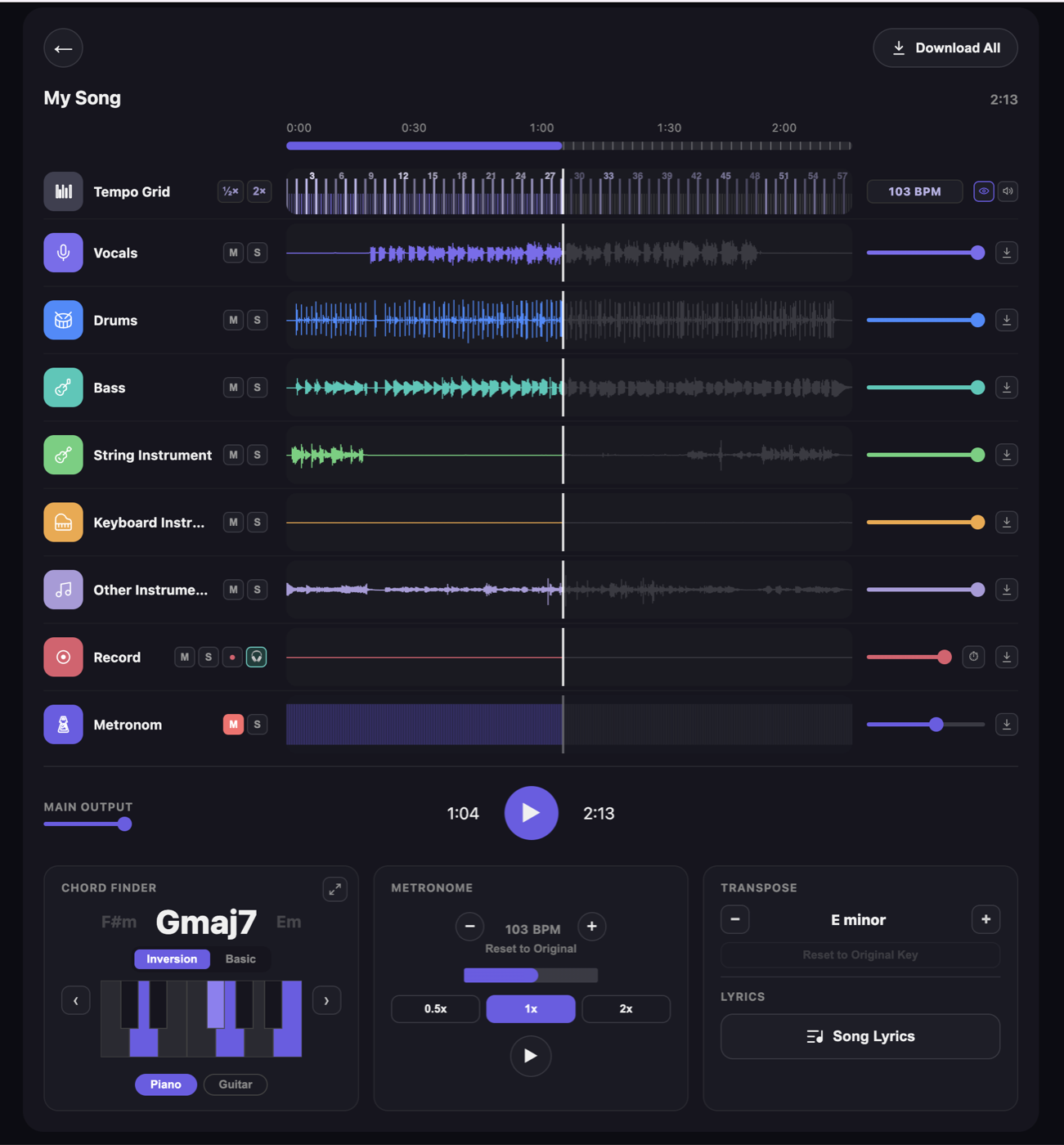
One window with everything the loop needs: stems with mute/solo, a record channel, speed control, transpose, chords. (This is VoxoMix, our app — you can run the same loop with other tools; it just takes more of them.)
Step 1: How do you find the right thing to practise?
Find the smallest unit that's actually broken, and practise only that. Not the song. Not the solo. The two beats where your hand does the wrong thing.
Play the section once, honestly, and notice where it collapses. It's almost never the whole passage — it's a specific transition: one finger change, one string skip, one bar where the rhythm shifts. That's your target.
This step is where most people lose the most time. Practising "the solo" means playing 90% material you already know in order to reach the 10% you don't. Twenty repetitions of the solo gives you twenty attempts at the hard bar. Twenty minutes on the hard bar alone gives you two hundred.
Rule of thumb: if your practice unit takes more than about 10 seconds to play, it's too big. Cut it down.
Step 2: Why separate the song into stems?
Because you can't practise against a wall of sound. Stem separation splits a recording into its parts — vocals, drums, bass, guitar, keys — so each one becomes a fader you control rather than a fixed lump.
That unlocks three things:
- Hearing your part clearly. Solo the guitar and you can finally hear what it's actually playing, instead of guessing under a cymbal wash.
- Muting your part. Turn the guitar off and the song is a backing track waiting for you.
- Rebuilding the mix for practice. Struggling with time? Bring drums and bass up, drop everything else. Learning a harmony? Solo the vocal.
Modern AI separation is good enough that this isn't a compromise anymore. It runs on your own computer in a couple of minutes, and if you're working on unreleased material, on-device processing means the song never leaves your machine.
Read more: offline stem separation and why local processing matters →
Step 3: How does muting your instrument help?
It removes the crutch. When the original guitar is playing, you're playing with a guitarist — and your ear can't tell whether the notes it's hearing are yours or theirs. Mute it and every mistake is unmistakably yours.
This is uncomfortable. That's the point. Playing along with the original recording feels great and teaches almost nothing, because the record is covering for you. Being the only guitar in the room is where you find out what you actually know.
Start with your part audible if the section is brand new, then mute it as soon as you have the shape. Don't stay on training wheels — the discomfort is the learning.
Step 4: How slow should you actually practise?
Slow enough to play it perfectly — which is almost always slower than your ego wants.
The critical mechanism: you're building a motor pattern, and the pattern doesn't know whether it's correct. Play a passage wrong at 90% speed twenty times and you have carefully rehearsed the mistake twenty times. Speed built on a broken pattern collapses under pressure, every time.
Use time-stretching, not raw playback speed — time-stretching drops the tempo while keeping the original key, so you can still play along in the same position. Rough guide on how far you can go before the audio degrades:
| Speed | Sounds like | Use for |
|---|---|---|
| 90–100% | Indistinguishable | Final run-throughs |
| 75–85% | Very clean | Most practice |
| 50–65% | Some artifacts, still clear | Learning fast passages |
| 25–40% | Metallic, smeared | Last resort — picking out single notes |
The test: if you make the same mistake twice, you are too fast. Drop 10%. There is no prize for struggling at a tempo you can't hold.
Read more: how to slow down a song without changing the pitch →
Step 5: Why record yourself?
Because you cannot hear yourself accurately while playing. Your attention is on your hands, your reading, the next change. The part of your brain that would evaluate the sound is busy producing it. Recording separates those two jobs.
Everyone resists this step and everyone who does it says the same thing: "I had no idea I was doing that." Rushing, dragging, buzzing strings, uneven dynamics, a chord change that's always a hair late — invisible while playing, obvious in playback.
The workflow: mute your instrument, record yourself in its place, then listen to the take against the rest of the band. In VoxoMix that's a record channel inside the song, with monitoring so you hear yourself in the headphones while you play, and WAV export if the take is worth keeping.
Two ways to use it that pay off immediately:
- Record slow, record fast, compare. The gap between them tells you exactly what the tempo is costing you.
- Record the same bar on day one and day four. Progress at this scale is invisible day to day and obvious across a week. This is the single best antidote to "I'm not getting anywhere."
Listen for one thing per take. Timing on this pass. Tone on the next. A list of six faults is demoralising and unusable; one fault is a task.
Step 6: How do you get back up to full speed?
Climb in 5% steps, and earn each one.
The gate: play it clean five times in a row. Miss one, the count restarts at zero. This is the part everyone skips and the part that does the work — it's what turns "I can play it if I concentrate" into "I can play it."
Then raise the tempo about 5% and re-earn the five. If you break down at the new speed, you went too early: drop back and rebuild. Some days you'll climb four steps, some days one. Both are progress.
Finish at 100% once, even if it's messy. Ending the session at full speed tells your brain what the target is.
The 5% ladder feels absurdly slow on day one. By day four it's startling. Musicians who climb it deliberately pass people who grind at full speed every session — not because they practise more, but because every repetition they play is a correct one.
What about chords and lyrics?
If you're learning a song by ear, chord detection saves the hours that used to go into guessing. Modern tools read the audio and give you the progression, with the shape on a fretboard or keyboard:
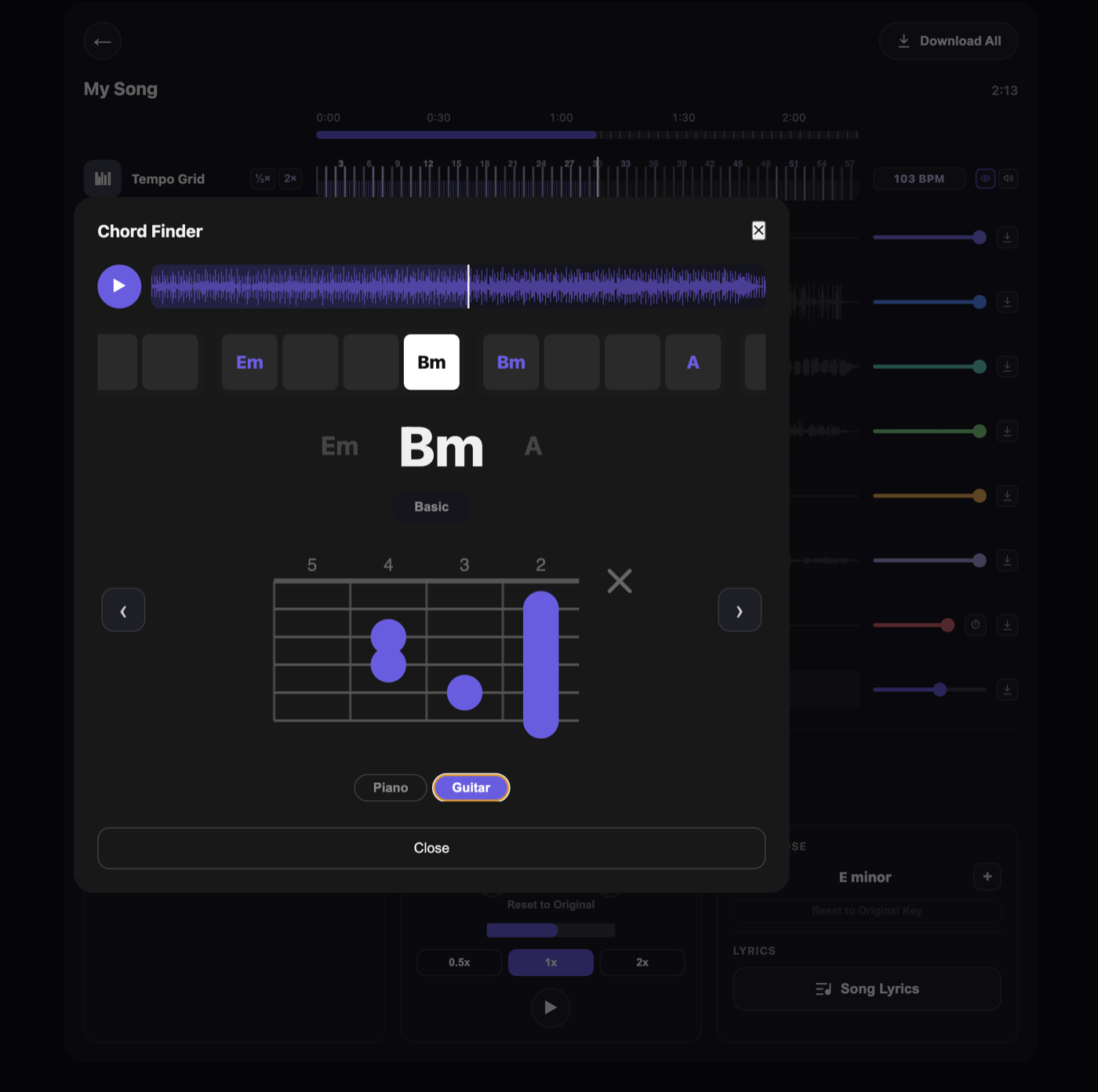
The chord timeline matters more than the chord name: seeing the change before it arrives is what lets you play through it instead of catching up after it. Lyrics transcription does the equivalent job for singers.
Honest caveat: no chord detection is perfect. Dense mixes, heavy distortion and extended jazz voicings are where every detector gets less reliable. Treat the output as a very strong first draft. Your ear is the final judge — and checking the detector against your ear is itself good training.
Should you transpose the song?
If you're singing: yes, without guilt. A song written for someone else's range isn't a test of your worth. Transposing to a key you can actually sing means you practise the song instead of practising failing at the high notes.
For instrumentalists it's more situational, but it's useful for getting a passage into an easier position while you learn the shape, then moving it back.
How long should a practice session be?
20–40 focused minutes beats two distracted hours. The loop is cognitively demanding — you're evaluating, correcting, and rebuilding patterns, not just moving. That burns out faster than passive playing.
Some principles worth more than extra time:
- Short and daily beats long and weekly. Motor learning consolidates during sleep. Six 30-minute sessions teach far more than one three-hour marathon.
- Interleave, don't block. Rotating between three hard sections is harder in the room and produces better retention than drilling one into the ground.
- Stop while it still works. Ending on a clean rep leaves the correct pattern as the last thing you rehearsed.
- Separate practice from playing. Give yourself 10 minutes at the end to just play something you already love, badly, for fun. It's what keeps you coming back.
What are the most common mistakes?
- Practising the whole song. You're rehearsing the 90% you know to reach the 10% you don't.
- Playing too fast, too early. The single biggest time-waster. Speed is a result, not a method.
- Playing along with your part audible. The record is covering for you.
- Never recording. You're grading your own work without ever looking at it.
- Chasing new songs. Starting a fourth song is more fun than finishing the third and teaches a quarter as much.
- Confusing time spent with progress. An hour of passive replay is an hour, not practice.
What tools do you actually need?
The loop needs five things: stem separation, mute/solo, tempo control that preserves pitch, a way to record yourself, and chords on screen.
You can assemble those from separate tools — a free separator for stems, a video platform or audio editor for tempo, a phone for recording, a tab site for chords. It works, and it costs nothing, but you'll spend more time managing files than playing.
Or you can have them in one window, which is why we built VoxoMix: stems with mute/solo, a record channel with monitoring, independent tempo and transpose, chord detection on piano and guitar, lyrics, a tuner, and a metronome locked to the song's BPM — all running on your own computer with no upload, on Mac and Windows. There's a free tier; paid plans run $2.99–$13.99/mo.
The tool matters far less than the loop. Use whatever removes the friction between "I can't play this" and "loop it at 60%."
Frequently asked questions
How do I practise a song that's too fast for me?
Slow it down with time-stretching (not playback speed, which drops the pitch too), find the tempo where you can play the section perfectly — often 50–60% — and climb back up in 5% steps, playing each speed cleanly five times in a row before advancing.
Is playing along with songs good practice?
It's good practice only if you're actively working a specific section: muting your part, slowing it down, recording and correcting. Playing along top-to-bottom at full speed with the original part audible is performing. It's enjoyable and it builds very little.
How do I get a backing track for any song?
Separate the song into stems and mute the instrument you play. The remaining stems are your backing track, made from the original recording. No special backing-track version needed.
How long does it take to learn a song?
A simple song with familiar chords: one or two focused sessions. Something with a real technical hurdle: one to three weeks of 20–40 minute daily sessions, most of that on a handful of hard bars. If you've spent a month on one song, you're probably replaying it rather than practising it.
Should I use a metronome or the song itself?
Both, for different jobs. The song teaches you musical time — how the part actually sits against the band. A metronome exposes whether your time is yours or borrowed. Drill the hard bar to a click, then put it back in the song.
Do I need to record myself every session?
No — but record often enough to keep yourself honest. Once a session on the section you're working, and one deliberate comparison across a week, is enough to catch the faults you can't hear while playing and to prove to yourself that you're moving.
The bottom line
Practice isn't hours logged, and it isn't talent. It's the loop: find the smallest broken thing, mute your part, slow it down until it's perfect, record it, listen, fix one thing, climb 5%.
It's slower than playing the song. It's less fun for the first twenty minutes. And it's the difference between playing a song at the end of the month and still playing at it.
Pick one hard bar today. Loop it at 60%. Record one take. That's the whole method — everything else is repetition.
About the author: Barış Demirel is a musician and the founder of VoxoMix, an offline AI music studio for practising musicians.
Download VoxoMix free and split your first song into stems right now.
Download Free